
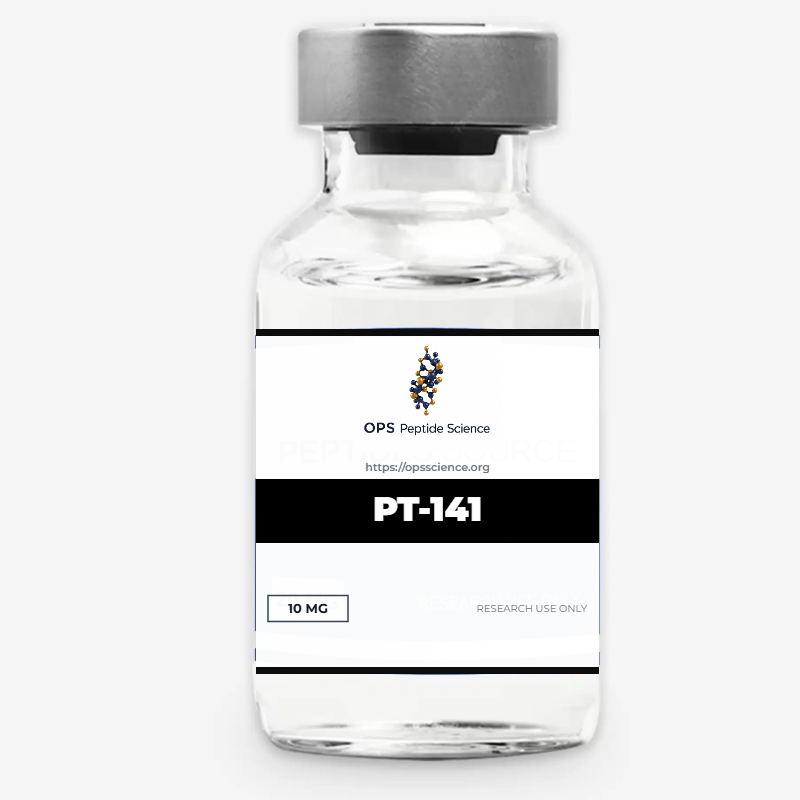
PT-141
$75.00
PT-141 stands as one of the few FDA-approved peptides on this entire list, with a clear medical role in treating women’s sexual health and emerging uses in men’s sexual medicine. Melanotan II remains more controversial, offering distinctive aesthetic and sexual benefits but with significant safety considerations that require careful evaluation and medical guidance.
PT-141
PT-141 (also known as Bremelanotide) and Melanotan II are synthetic peptides that belong to a fascinating class of compounds known as melanocortin receptor agonists. Both are derivatives of alpha-Melanocyte-Stimulating Hormone (α-MSH) — a natural hormone produced by the pituitary gland that regulates pigmentation, sexual function, appetite, inflammation, and several other key physiological processes.
While these two peptides share a common ancestor and many similar effects, they have evolved into distinct tools with different primary uses:
- PT-141 (Bremelanotide) — Specifically developed and FDA-approved as a sexual health treatment, particularly for Hypoactive Sexual Desire Disorder (HSDD) in premenopausal women under the brand name Vyleesi.
- Melanotan II — A broader-spectrum melanocortin agonist most popular for skin tanning effects alongside libido-enhancing properties — though it is not FDA-approved.
In 2026, both peptides remain among the most discussed and used compounds in the world of sexual health, libido enhancement, and aesthetic peptide therapy.
How PT-141 and Melanotan II Work: Mechanism of Action
These peptides produce their effects through several precise biological pathways:
- Melanocortin receptor activation: Both peptides activate melanocortin receptors — particularly MC3R and MC4R in the brain (sexual function and appetite regulation) and MC1R in the skin (pigmentation).
- Central nervous system effects: Unlike PDE5 inhibitors (Viagra, Cialis), which work through blood flow, PT-141 works centrally in the brain — directly stimulating the neural pathways involved in sexual desire and arousal.
- Increased melanin production: Through MC1R activation, Melanotan II stimulates melanocytes in the skin to produce more melanin, the pigment responsible for skin coloration.
- Reduced inflammation: Melanocortin receptors play a role in inflammatory regulation throughout the body.
- Appetite modulation: Both peptides can affect appetite through MC4R activation.
- Neuroprotective effects: Emerging research suggests melanocortin pathways may have broader neuroprotective benefits.
This central nervous system mechanism distinguishes PT-141 and Melanotan II from virtually every other sexual health treatment on the market.
Top Benefits of PT-141 (Bremelanotide)
PT-141 offers a focused range of sexual health benefits:
- Increased libido and sexual desire — central nervous system enhancement.
- Improved sexual arousal — particularly in women with HSDD.
- Better sexual responsiveness — for both men and women.
- Erectile support in men — through different mechanisms than PDE5 inhibitors.
- Effective even in cases unresponsive to Viagra/Cialis — due to its central action.
- Spontaneous use — taken as needed before sexual activity.
- Beneficial for psychogenic sexual dysfunction — particularly stress- or anxiety-related cases.
- Improvement in sexual satisfaction — including emotional dimensions.
Top Benefits of Melanotan II
Melanotan II offers a broader range of effects that combine cosmetic and sexual benefits:
- Increased skin pigmentation — deeper, longer-lasting tans with reduced UV exposure.
- Reduced UV exposure needs — potentially less sun damage during tanning.
- Sexual function enhancement — similar mechanisms to PT-141.
- Appetite suppression — through MC4R activation.
- Potential fat loss support — modest metabolic effects.
- Anti-inflammatory effects — through melanocortin pathway action.
PT-141 for Female Sexual Dysfunction: The Vyleesi Story
PT-141’s most celebrated application is in the treatment of Hypoactive Sexual Desire Disorder (HSDD) in premenopausal women — a condition characterized by chronically low sexual desire causing personal distress. Approved by the FDA in 2019 as Vyleesi, PT-141 represented a major breakthrough in women’s sexual health.
What makes PT-141 unique for women is that it addresses the psychological and neurological aspects of desire — not just the physical mechanics. For women whose sexual dysfunction stems from low desire rather than mechanical issues, PT-141 offers something traditional sexual health medications cannot.
Reported benefits include:
- Increased sexual desire
- Improved sexual arousal
- Better emotional engagement during sexual activity
- Reduced distress around sexual function
- A renewed sense of sexual interest
PT-141 for Male Sexual Dysfunction
PT-141 is also used off-label for male sexual dysfunction, particularly in cases where PDE5 inhibitors (Viagra, Cialis) are insufficient or contraindicated. Because PT-141 works centrally rather than through blood flow:
- It can support libido in addition to erectile function
- It works in some cases where Viagra fails
- It addresses psychological components of dysfunction
- It can be used by men with cardiovascular conditions that contraindicate PDE5 inhibitors
This central mechanism makes PT-141 a valuable addition to the male sexual health toolkit.
Melanotan II for Tanning and Skin Pigmentation
Melanotan II’s most popular use is skin pigmentation enhancement — producing deeper, more even tans with significantly less UV exposure than would otherwise be required. Reported benefits include:
- Deeper, longer-lasting tans
- Reduced UV exposure required for tanning
- More uniform skin pigmentation
- Potential reduction in sun damage during tanning
- Enhanced skin appearance for cosmetic purposes
While these benefits have made Melanotan II popular among aesthetic users, the peptide’s lack of FDA approval and broader side-effect profile mean it should be approached with significant caution.
PT-141 and Melanotan II Research and Clinical Evidence
The two peptides occupy very different evidence tiers:
- PT-141 (Bremelanotide) sits in the FDA-approved evidence tier with multiple Phase 3 clinical trials supporting its use for HSDD in premenopausal women. Its scientific foundation is strong and well-validated.
- Melanotan II sits in a moderate preclinical and observational evidence tier, with research demonstrating its tanning and sexual effects but limited large-scale human clinical trials and no FDA approval.
This regulatory and scientific difference is essential for users to understand before considering either peptide.
PT-141 Side Effects and Safety Profile
PT-141 has a generally well-tolerated side-effect profile, though it is more pronounced than many wellness peptides:
- Nausea is the most common side effect (40% in clinical trials)
- Flushing or warmth after dosing
- Headache
- Temporary increase in blood pressure
- Injection site irritation
- Vomiting (less common)
- Possible darkening of skin or moles (long-term, more relevant for repeat use)
Most side effects are dose-dependent and subside as the peptide is metabolized.
Melanotan II Side Effects and Safety Profile
Melanotan II’s side-effect profile is broader and more concerning than PT-141’s:
- Nausea, especially at first use
- Facial flushing and warmth
- Significant darkening of moles and freckles
- Potential development of new moles
- Sustained erections (in men)
- Blood pressure changes
- Possible long-term unknown effects of melanocortin overactivation
- Concerns about increased melanoma risk (under investigation)
The mole darkening and potential melanoma concerns are particularly important — anyone considering Melanotan II should undergo regular dermatological skin checks and approach the peptide with careful medical supervision.
Regulatory Status: Are PT-141 and Melanotan II Legal in 2026?
The regulatory profiles of these two peptides differ significantly:
- PT-141 (Bremelanotide): FDA-approved under the brand name Vyleesi for HSDD in premenopausal women. Off-label use is common but should be done under qualified medical supervision.
- Melanotan II: Not FDA-approved anywhere in the world. Available as a research-grade compound through specialized suppliers. Multiple national health agencies have issued warnings about its use.
WADA: Both peptides may fall under WADA scrutiny for competitive athletes; verify with specific sport regulations.
How Are PT-141 and Melanotan II Administered?
Both peptides are most commonly administered via subcutaneous injection:
- PT-141 (Vyleesi) — Typically used as needed, approximately 45 minutes before sexual activity. Comes in a prefilled auto-injector.
- Melanotan II — Typically administered in a loading phase of daily small doses followed by maintenance phase dosing once tanning effects are achieved. Some users opt for nasal sprays, though injection is most reliable.
Specific dosing should always be determined by a qualified medical provider.
PT-141 vs Melanotan II: Which Should You Choose?
The choice between these peptides depends entirely on your goals and tolerance for risk:
- For sexual health alone: PT-141 is the clear choice — FDA-approved, well-studied, and safer.
- For combined tanning and sexual effects: Melanotan II offers both, but carries significantly more risk and lacks FDA approval.
- For cosmetic tanning alone: Neither peptide is ideal — safer alternatives exist for skin pigmentation.
- For medical legitimacy: PT-141 has FDA approval; Melanotan II does not.
PT-141 vs Other Sexual Health Treatments
How does PT-141 compare to other sexual health options?
- PT-141 vs Viagra/Cialis (PDE5 inhibitors): PT-141 works centrally on desire; PDE5 inhibitors work peripherally on blood flow. Often complementary rather than competing.
- PT-141 vs flibanserin (Addyi): Both treat female HSDD; PT-141 is taken as needed, flibanserin daily. Different mechanisms and side-effect profiles.
- PT-141 vs testosterone therapy: Testosterone addresses hormonal libido issues; PT-141 addresses neural desire pathways. Sometimes used together.
Frequently Asked Questions About PT-141 and Melanotan II
Is PT-141 only for women? No — while it is FDA-approved for women with HSDD, PT-141 is also used off-label for male sexual dysfunction with reported success.
How fast does PT-141 work? Effects typically begin within 30–60 minutes of injection and may last several hours.
Can PT-141 be combined with Viagra? Many users and clinicians combine the two for complementary effects (central + peripheral). However, this should only be done under medical supervision due to potential blood pressure interactions.
Is Melanotan II safe? Melanotan II is not FDA-approved and has significant safety concerns including mole changes and potential melanoma risk. It should only be used with full medical awareness and regular dermatological monitoring.
Will Melanotan II work without sun exposure? Some tanning effect can occur, but UV exposure significantly enhances pigmentation results.
Can these peptides be used long-term? PT-141 is designed for as-needed use; Melanotan II is sometimes used cyclically. Long-term safety data is limited for both, particularly for Melanotan II.
| Dosage | 10 mg |
|---|
Be the first to review “PT-141”
Related products
GH
Sexual
Cognitive
Cognitive
GLP-1
GLP-1
GH
Reviews
There are no reviews yet.