Peptide Education, Research Protocols
What Do Copper Peptides Do For Your Skin? Complete Research Guide
May
Research Use Only Notice: This article discusses copper peptides as research compounds in dermal and skin biology studies. Compounds discussed are intended for in-vitro and animal research applications. Nothing here constitutes medical advice, dermatologic guidance, or instructions for personal cosmetic use.
What do copper peptides do for your skin? In research models, copper peptides — primarily GHK-Cu, a tripeptide bound to a copper ion — have been documented to upregulate collagen synthesis, modulate fibroblast activity, accelerate wound-healing markers, and influence gene expression patterns across thousands of skin-biology-related genes. This guide from the chemistry team at OPS Peptide Science walks through what the published research literature actually documents about copper peptides and skin, the mechanisms involved, and how research-grade copper peptides differ from cosmetic-grade formulations.
For practical research workflow context, our companion guides on how to reconstitute peptides and peptide stability and storage cover the laboratory protocols underlying any copper peptide research.
What Are Copper Peptides?
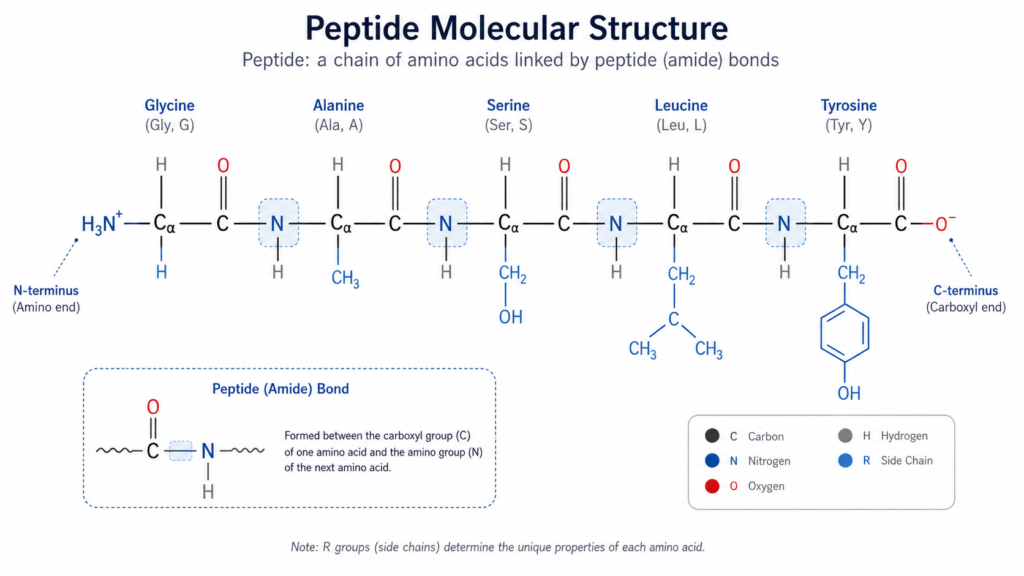
Copper peptides are short amino acid chains that bind a copper ion at a specific coordination site. The most studied copper peptide is GHK-Cu — glycyl-L-histidyl-L-lysine bound to copper (Cu²⁺). The compound occurs naturally in human plasma at concentrations that decline progressively with age, a feature that has driven significant research interest in supplementing exogenous GHK-Cu for skin biology endpoints.
Other copper peptides studied in research include:
- AHK-Cu — alanyl-histidyl-lysine copper, a closely related copper tripeptide
- GHK-Cu derivatives — variants with modified amino acid sequences studied for stability or specificity
- Custom copper-binding peptide research — emerging area in dermal biology research
The copper coordination is structurally important — uncomplexed GHK has measurably different activity than GHK-Cu in research models. The copper ion is what enables many of the documented downstream effects on skin biology pathways.
What Do Copper Peptides Do for Your Skin? Direct Answer
Research literature documents copper peptides — particularly GHK-Cu — producing measurable effects across five major skin biology pathways:
- Collagen synthesis upregulation — fibroblast cultures exposed to GHK-Cu produce measurably more Type I collagen than control conditions
- Fibroblast activity modulation — increased fibroblast proliferation and migration in research models
- Wound healing acceleration — documented in dermal injury models across multiple species
- Gene expression changes — published research has measured modulation of over 4,000 genes related to repair, regeneration, and aging biology
- Antioxidant effects — copper-related enzyme systems are involved in cellular oxidative stress response
These are research-documented endpoints, not therapeutic claims. The research peptides for skin in this category are studied in laboratory and animal models — they are not FDA-approved as skin treatments in the United States. The published GHK-Cu skin biology literature on PubMed is the authoritative source for the underlying studies.
How GHK-Cu Affects Collagen Synthesis in Research
The most extensively documented effect of copper peptides for skin is on collagen synthesis. Research findings:
- Type I collagen production — fibroblast cultures show measurable increases in Type I collagen synthesis when exposed to GHK-Cu at research-grade concentrations
- Glycosaminoglycan synthesis — hyaluronic acid and related GAGs are upregulated alongside collagen
- Decorin and other ECM proteins — extracellular matrix protein production increases across the connective tissue protein family
- Metalloproteinase modulation — research has documented changes in collagen-degrading enzyme expression, suggesting a net pro-synthesis effect
This is why GHK-Cu is one of the most-studied research peptides for skin care and dermal research — the collagen synthesis effect is well-characterized and reproducible across multiple research models.
Copper Peptides and Wound Healing Research
Beyond collagen, copper peptides have been studied extensively in wound-healing research models:
- Angiogenesis — new blood vessel formation in injury sites accelerates in GHK-Cu-treated research models
- Inflammatory marker reduction — pro-inflammatory cytokine levels decrease in research-grade copper peptide exposure
- Granulation tissue formation — improved granulation tissue quality in dermal wound research
- Re-epithelialization — measurably faster epithelial recovery in animal models
The wound-healing research provides much of the foundation for understanding what copper peptides do for skin at the cellular level — the same pathways involved in repair are involved in continuous skin maintenance.
Copper Peptides and Antioxidant Effects
Copper is a cofactor for several antioxidant enzymes in cellular biology — most notably superoxide dismutase (SOD). Research on GHK-Cu has documented:
- Reactive oxygen species reduction — measurable decreases in cellular ROS in copper peptide research models
- SOD activity modulation — increased antioxidant enzyme activity
- Lipid peroxidation reduction — markers of oxidative damage decrease
- Glutathione system effects — interaction with cellular glutathione-dependent antioxidant pathways
Because skin tissue experiences continuous oxidative stress from UV exposure, environmental factors, and metabolic activity, antioxidant pathways are central to dermal aging research. Copper peptides act on these pathways in addition to their direct collagen and fibroblast effects.
What Can I Use With Copper Peptides in Research?
The question of what can be combined with copper peptides comes up frequently in research design. Compounds commonly studied alongside copper peptides:
- Hyaluronic acid — studied alongside GHK-Cu in dermal hydration research
- Vitamin C (L-ascorbic acid) — synergistic in collagen synthesis research, though pH considerations apply
- Glutathione — antioxidant research alongside copper peptide ROS effects
- Other copper peptides like AHK-Cu — comparative or combinatorial dermal biology research
- BPC-157 and TB-500 — broader healing peptide research stacks (see the GLOW Stack research formulation)
Important compatibility note for research design: copper peptides should generally not be combined with strong reducing agents (which can strip the copper from the peptide complex) or with chelating agents (which can sequester the copper). Research on copper peptide combinations with vitamin C in topical formulations has documented pH-dependent interactions that require careful protocol design.
Research-Grade vs. Cosmetic-Grade Copper Peptides
Copper peptides exist in two distinct regulatory categories in the United States:
- Cosmetic-grade GHK-Cu — permitted as a cosmetic ingredient in skin care products at specific concentrations. Sold as a finished cosmetic, not as a research compound.
- Research-grade GHK-Cu — sold under research-use-only labeling for in-vitro and animal research. Typically higher purity (99%+) and supplied in vials for laboratory reconstitution, with per-lot Certificates of Analysis verifying purity through HPLC-MS analysis.
The two are not interchangeable. Cosmetic formulations are designed for topical use at controlled concentrations within a finished product matrix. Research-grade compounds are reagents for laboratory studies, sold under research-use-only labeling and never for human consumption. According to research from NIH-affiliated dermal research programs, the bioavailability and stability profiles differ significantly between the two grades.
FAQ
Are copper peptides the best peptides for skin research?
For collagen synthesis and wound-healing endpoints, copper peptides like GHK-Cu have the most published research literature. Other peptides for skin care research include melanocortin peptides (Melanotan 1 and 2) for pigmentation, and Snap-8 for facial muscle research. “Best” depends entirely on the specific skin biology endpoint being studied.
How long does it take for copper peptides to show effects in research?
In cell culture studies, fibroblast and collagen synthesis effects appear within days. In animal dermal research models, measurable skin biology changes typically appear over 4–12 weeks of consistent dosing protocols. Specific timelines depend on the endpoint and research design.
Can copper peptides be combined with retinol in research?
Research design considerations apply — retinol and copper peptides act on overlapping pathways (collagen biology, gene expression) but through different mechanisms. Combination research exists in the literature, though pH and stability interactions require careful formulation. Direct combinations in the same delivery system may have stability concerns; alternating or separated administration is the more common research approach.
What’s the difference between GHK and GHK-Cu?
GHK is the uncomplexed tripeptide (glycyl-L-histidyl-L-lysine). GHK-Cu is the same peptide bound to a copper ion. The copper coordination is functionally important — research has documented different activity profiles between GHK and GHK-Cu, with most of the skin-biology effects attributed to the copper-bound form.
Are research-grade copper peptides legal to buy?
Yes — research-grade copper peptides are legally sold in the US under research-use-only labeling for in-vitro and animal study. They are not sold or prescribed for human consumption. See our detailed guide on are peptides illegal for the full US legal framework.
Copper peptides — particularly GHK-Cu — represent one of the most extensively documented compound categories in skin biology research. The published literature spans collagen synthesis, fibroblast activity, wound healing, antioxidant pathways, and gene expression modulation. For researchers studying any of these endpoints, copper peptides remain one of the most-cited tools in the modern dermal-biology compound library.
For research-grade copper peptides backed by per-lot Certificates of Analysis and full HPLC-MS purity documentation, browse the OPS Peptide Science catalog, visit the OPS Peptide Science homepage for the full product overview, or verify a specific lot using its COA code.
Author: Shane Straight, Principal Chemist, OPS Peptide Science
Reviewed: May 2026