
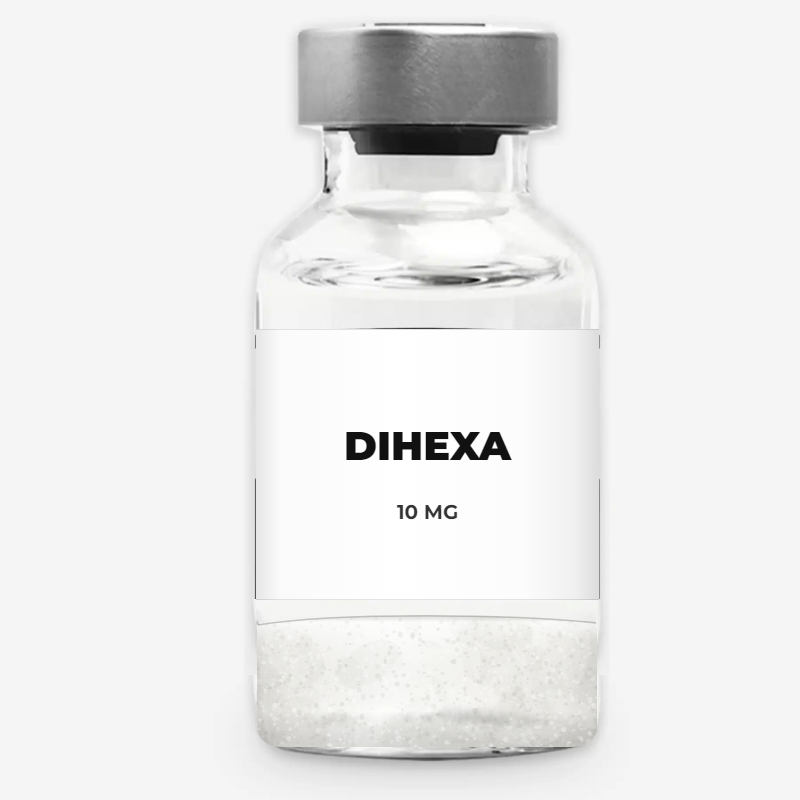
Dihexa
$129.00
Dihexa (N-hexanoic-Tyr-Ile-(6) aminohexanoic amide) is a small angiotensin IV derived peptide studied for hepatocyte growth factor / c-Met signalling and synaptogenesis in cognitive research models. Supplied as a 10 mg lyophilized vial, sold as a 10-vial kit. Every lot is independently assayed by HPLC-MS and published in our COA library. For research use only.
Dihexa
Dihexa (N-hexanoic-Tyr-Ile-(6) aminohexanoic amide, also written as PNB-0408) is a small synthetic peptide derived from angiotensin IV. It is one of the most studied compounds in the angiotensin IV analogue family, investigated primarily for its effects on synapse formation and neural connectivity in cognitive research models.
Unlike most nootropic peptides, Dihexa was designed for metabolic stability and lipophilicity, two properties that determine how a compound behaves in blood-brain barrier permeability research. That design is the reason it appears so frequently in preclinical neuroscience literature.
How Dihexa Works: Mechanism of Action
Research into Dihexa centres on a small number of well-defined pathways:
- HGF / c-Met potentiation: Dihexa is studied as a positive modulator of hepatocyte growth factor (HGF) and its receptor c-Met — a signalling axis closely tied to neurite outgrowth and synapse assembly.
- Synaptogenesis: Preclinical work reports formation of new functional synaptic connections in hippocampal models, which is the primary reason the compound is investigated for memory research.
- Angiotensin IV pathway activity: As an AngIV analogue, Dihexa retains activity at targets associated with the brain renin-angiotensin system.
- Metabolic stability: Structural modification of the parent peptide substantially extends its half-life relative to angiotensin IV itself.
- Lipophilicity: The hexanoic acid modification increases lipid solubility, a property studied in the context of central nervous system distribution.
Primary Research Applications
- Memory and learning models — the most frequently published application.
- Synaptic plasticity research — dendritic spine density and synapse counts.
- Neurorepair and neuroregeneration models — via the HGF/c-Met axis.
- Neurodegeneration research — including scopolamine-impairment and lesion models.
- Blood-brain barrier permeability studies — as a reference lipophilic peptide.
- Comparative nootropic research — benchmarked against Semax, Selank, and Cerebrolysin.
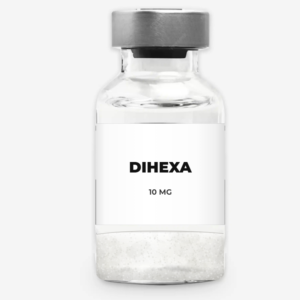
Product Specification
- Compound: Dihexa (N-hexanoic-Tyr-Ile-(6) aminohexanoic amide)
- Molecular weight: 490.64 g/mol
- Presentation: 10 mg lyophilized powder per vial
- Kit size: 10 vials per kit (100 mg total)
- Appearance: White to off-white lyophilized powder
- Purity: ≥ 99% by RP-HPLC (214 nm)
- Lot tested: BVR-2026-0135-DHX10 — 99.312% purity, 10.21 mg content
Handling and Storage
- Store the sealed vials in a cool, dry place away from direct sunlight.
- For long-term storage, keep lyophilized material frozen.
- After reconstitution, refrigerate at 2–8°C and use within the period appropriate to your protocol.
- Reconstitute with bacteriostatic water; avoid repeated freeze-thaw cycles.
- Bacteriostatic water and syringes are sold separately and are not included with this kit.
Certificate of Analysis
Every Dihexa lot is assayed by an independent laboratory for identity, purity and content before release. The certificate for the current lot is published in full — identity confirmed by MALDI-MS, purity by RP-HPLC at 214 nm, and content by HPLC quantitation.
Verify this lot at opsscience.org/verify using lot number BVR-2026-0135-DHX10.
Frequently Asked Questions
How much Dihexa is in one kit? Each kit contains 10 vials of 10 mg, for 100 mg of lyophilized Dihexa in total.
What makes Dihexa different from other cognitive peptides? Most research peptides in this category act on neurotransmitter or neurotrophic signalling broadly. Dihexa is studied specifically through the HGF/c-Met pathway and for direct synapse formation, which is a narrower and more mechanistically defined target.
Is Dihexa a peptide or a small molecule? It is a small peptide derivative — a modified tripeptide analogue of angiotensin IV — with a molecular weight of 490.64 g/mol, which is far smaller than most research peptides.
Does it require refrigeration on arrival? The lyophilized powder is stable at room temperature for shipping. Refrigeration or freezing is recommended for storage, and refrigeration is required after reconstitution.
Is this product for human use? No. Dihexa is supplied strictly for laboratory research. It is not a drug, food, or cosmetic, and is not intended to diagnose, treat, cure, or prevent any disease.
| Dosage | 10 mg |
|---|
Be the first to review “Dihexa”
Related products
Cognitive
Cognitive
Cognitive
Cognitive
Cognitive
Reviews
There are no reviews yet.